

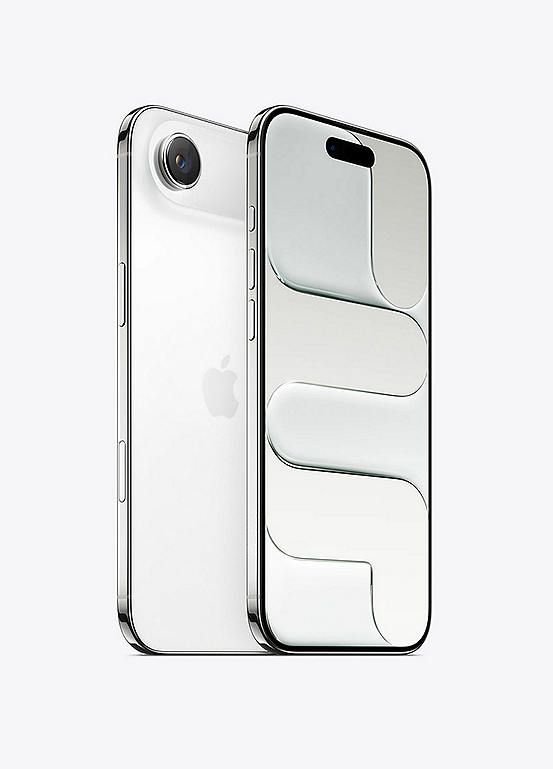
You can buy it using this link : Iphone Air
When rumors first hinted that Apple was replacing its “Plus” line with a radically slimmed-down smartphone, many industry analysts questioned whether a modern flagship could be engineered without sacrificing structural integrity, performance, or battery life.
The answer arrives in the form of the iPhone Air.
Measuring an astonishing $5.6\text{ mm}$ thin and crafted from Grade-5 titanium, the iPhone Air is Apple’s thinnest smartphone ever created. It is not just a phone; it is a statement of industrial engineering.
Today at Nabil IT, we test the iPhone Air to see if its breathtaking design holds up against daily real-world demands.
1. Design & Ergonomics: Unprecedented Thinness
Holding the iPhone Air for the first time is a surreal experience. Weighing remarkably light with a profile thinner than an iPad Pro, the device disappears into your hand and pocket.
[ iPhone 17 Pro ] ➔ 8.75 mm Thickness | Heavy Titanium Frame
[ iPhone Air ]    ➔ 5.60 mm Thickness | Grade-5 Lightweight Titanium Unibody
Build & Structural Integrity:
- Grade-5 Titanium Frame: Ensures structural rigidity, completely eliminating flexing concerns despite its ultra-slim profile.
- Display Profile: Features a $6.5\text{-inch}$ Super Retina XDR OLED screen with a $2736 \times 1260$ resolution at $460\text{ ppi}$.
- $120\text{ Hz}$ ProMotion & Always-On Display: Adapts dynamically down to $1\text{ Hz}$ to preserve battery power when stationary.
2. In-House Silicon: The A19 Pro and C1X Modem
To achieve such extreme thinness, Apple could not rely on off-the-shelf internal components. The iPhone Air serves as the debut vehicle for several proprietary silicon breakthroughs:
- $A19\text{ Pro}$ Processor: Features a $6\text{-core}$ CPU, $5\text{-core}$ GPU, and $16\text{-core}$ Neural Engine built for extreme power efficiency.
- Apple $C1X\text{ Modem}$: Apple’s custom-designed cellular modem replacing legacy chips, engineered specifically to consume minimal motherboard surface area while maintaining $5\text{G}$ Advanced speeds.
- Apple $N1\text{ Networking Chip}$: Handles Wi-Fi 7, Bluetooth 6.0, and Thread protocol connectivity natively on a single micro-die.
3. The Camera Compromise: Single 48 MP Fusion Lens
Achieving a $5.6\text{ mm}$ chassis required Apple to make its most significant trade-off: a single rear camera module.
[ Rear Module ] ➔ Single 48 MP Fusion Lens (f/1.8) ➔ 1x & Lossless 2x Crop
Camera Capabilities:
- $48\text{ MP}$ Fusion Sensor: Captures clean, high-detail shots with fast autofocus and natural color rendering. Supports a $2\times$ lossless optical crop ($12\text{ MP}$).
- Limitations: Due to the absence of an ultra-wide sensor, the iPhone Air cannot take spatial photos or macro close-ups.
- Innovative Front Camera: The front housing features an $18\text{ MP}$ Center Stage camera with Apple’s first square sensor, allowing you to dynamically rotate portrait and landscape video fields of view without physically tilting the phone.
4. Battery Life and Daily Practicality
The immediate concern for any ultra-thin smartphone is battery longevity. Apple addressed this by combining an energy-dense internal battery layout with the hyper-efficient $A19\text{ Pro}$ chip and custom wireless modems.
- Real-World Battery Performance: The iPhone Air delivers a solid full-day battery life ($\sim 6.5\text{ to } 7\text{ hours}$ SOT). While it does not match the multi-day endurance of the heavy Pro Max, it comfortably gets light-to-moderate users through a full workday.
- Charging & Ports: Equipped with a USB-C port supporting fast wired charging and MagSafe wireless charging up to $25\text{ W}$.
Tech Specs Overview: iPhone Air
| Feature | Specification |
|---|---|
| Thickness / Weight | $5.6\text{ mm}$ / Super Lightweight Titanium |
| Display | $6.5\text{-inch}$ OLED, $120\text{ Hz}$ ProMotion, $3,000\text{ nits}$ Peak |
| Chipset | Apple $A19\text{ Pro}$ with $16\text{-core}$ Neural Engine |
| Cellular & Wireless | Apple $C1X\text{ 5G Modem}$ + Apple $N1\text{ Wi-Fi 7/BT 6.0 Chip}$ |
| Rear Camera | Single $48\text{ MP}$ Fusion Lens ($1\times$ and $2\times$ Lossless Crop) |
| Front Camera | $18\text{ MP}$ Center Stage Square Sensor |
Pros and Cons
Pros:
- Unmatched $5.6\text{ mm}$ ultra-thin design and lightweight titanium feel.
- $120\text{ Hz}$ ProMotion OLED screen with $3,000\text{ nits}$ peak brightness.
- Powered by $A19\text{ Pro}$ and Apple’s custom-engineered $C1X$ modem.
- Stunning square-sensor front camera for creative video framing.
Cons:
- Single rear camera means no ultra-wide, telephoto, or macro capabilities.
- Battery life, while respectable, is lower than standard and Pro models.
- USB-C transfer speeds are limited to USB 2.0 ($480\text{ Mbit/s}$).
Final Verdict
The iPhone Air is a triumph of miniaturization engineering. It is not designed for power users who demand triple-camera rigs or maximum battery capacity; rather, it is crafted for tastemakers, minimalists, and tech enthusiasts who value futuristic aesthetics and effortless portability above all else.
Is ultra-thin design worth the single-camera trade-off for you? Drop your thoughts in the comments below, and don’t forget to subscribe to Nabil IT for more cutting-edge hardware reviews!