

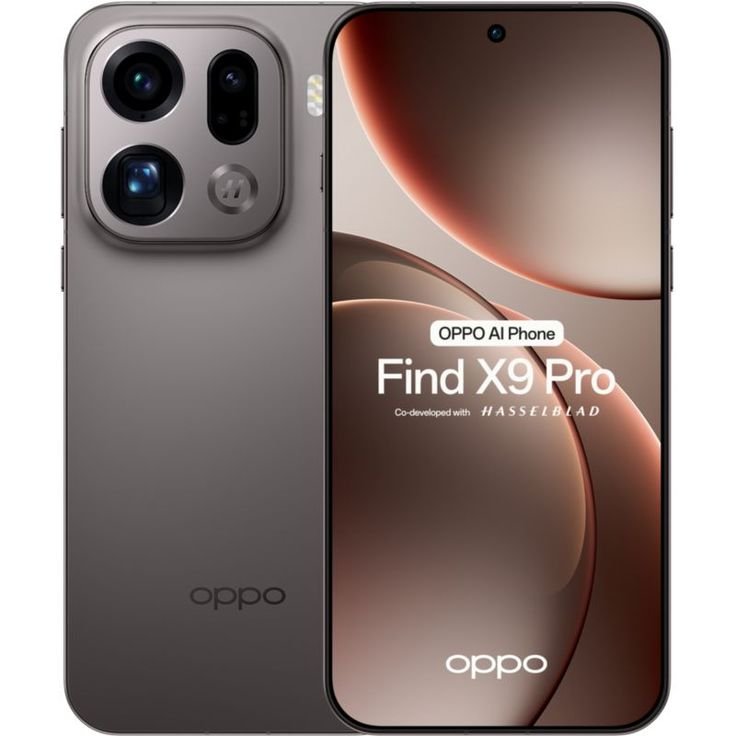
You can buy it using this link : OPPO FIND X9
For years, Oppo’s most ambitious camera flagships stayed largely confined to China, leaving global buyers to read about them from the sidelines. That changes with the Find X9 Ultra, which launched worldwide in May, everywhere except the United States, at a price and spec sheet clearly aimed straight at Samsung’s Galaxy S26 Ultra. Several reviewers have already called it the best camera phone ever made. Here’s a detailed look at whether that title is deserved.
Design and Build
The Find X9 Ultra doesn’t try to hide what it’s built around. Its rear camera housing is large enough that reviewers have compared its look to “a giant Oreo cookie,” and at 8.7mm thick for the body, closer to double that at the camera bump, plus 235 grams, it’s a genuinely substantial phone to carry. The 6.82-inch display uses 2K resolution with a 144Hz refresh rate, protected by Gorilla Glass Victus 2, and the bezels have been trimmed to a remarkably tight 0.03mm. Build quality is consistently described as tank-like, with a textured back panel that adds real grip despite the phone’s size. It’s IP66, IP68, and IP69 rated, covering dust, standard water immersion, and high-pressure water jets, under what Oppo calls its Armour Shield design. It comes in two finishes: Tundra Umber, with a vegan leather back, and Canyon Orange.
Performance, and an Odd RAM Decision
Under the hood sits Qualcomm’s Snapdragon 8 Elite Gen 5, currently among the fastest mobile chipsets available, paired with Wi-Fi 7 support. The global model ships with 12GB of RAM and 512GB of storage as standard, with a 16GB/1TB configuration available in select markets. Cuhttps://nabil-it.com/wp-content/uploads/2024/12/vintage-electrical-and-electronic-appliances-in-an-2023-11-27-05-10-10-utc-e1734923695564.jpgusly, that means the flagship Ultra actually ships with less RAM than the cheaper Find X9 Pro, which comes with 16GB standard. Oppo hasn’t explained the decision publicly, but it lines up with a broader industry story this year: a global memory chip shortage, driven largely by AI data center demand, has been pushing manufacturers to make exactly these kinds of trade-offs across the board. In day-to-day use, reviewers haven’t reported the lower RAM causing noticeable slowdown, though a few noted some GPU stability dips during prolonged, demanding sessions like extended gaming.
The Camera System: This Is the Whole Point
Everything about the Find X9 Ultra is built around its camera, and it shows. The rear setup packs five lenses, every one of them co-developed with Hasselblad:
- Main camera: 200MP, with a 1/1.12-inch sensor, the largest 200MP sensor ever fitted to a phone, an f/1.5 aperture, a 23mm-equivalent focal length, and 2-axis optical image stabilization.
- Ultra-wide: 50MP, f/2.0, a 14mm-equivalent focal length with a 123-degree field of view, upgraded this generation with a larger sensor for better low-light performance.
- 3x telephoto: 200MP, again the largest telephoto sensor ever used in a phone, f/2.2 aperture, a 70mm-equivalent focal length, and a close 15cm minimum focus distance.
- 10x telephoto: 50MP, f/3.5, built around an industry-first Quintuple Prism Reflection Periscope with sensor-shift stabilization, extending to up to 120x digital zoom.
- True Color Camera: a 3.2MP, 24-channel spectral sensor that now works across motion photos and video, not just stills, feeding into more accurate color reproduction.
The front camera also got a bump this generation, to a 50MP Samsung JN5 sensor with autofocus and an f/2.0 aperture.
In practice, reviewers have been genuinely impressed. Android Authority called the setup capable of making “the latest iPhone and Galaxy camera specs look positively second-rate,” while 9to5Google’s reviewer described it as blowing them away “on the regular,” with results that “simply do not look like smartphone images.” Oppo’s processing pipeline draws particular praise: initial shots can look a little rough straight out of the sensor, but the finalized, processed image typically ends up better than expected within a couple of seconds. A dedicated Master mode offers AI-free RAW capture for photographers who want full manual control without computational processing layered on top.
Video is more of a mixed bag. Every lens can shoot up to 4K at 60fps in Dolby Vision or Log, with the main and 3x telephoto lenses pushing to 4K 120fps, and real-time LUTs can be previewed live or burned directly into the final file. But multiple reviewers flagged that video output is noticeably softer than stills, and that switching between lenses while recording produces a visible “pop” as the system hands off from one sensor to another, since there’s currently no manual mode to lock recording to a single lens throughout a shot.
For photographers who want to push further, Oppo sells an optional Hasselblad Earth Explorer Kit, a phone case with a 67mm filter ring and a 30x teleconverter attachment, extending the 3x telephoto lens out to a 300mm-equivalent optical range (roughly 690mm of optical-quality reach with digital assistance). It’s a genuinely capable accessory, though several reviewers noted the built-in 10x zoom is strong enough on its own that they rarely reached for the extra kit in practice.
Battery and Charging
The Find X9 Ultra’s 7,050mAh battery is the largest among its direct Ultra-tier rivals, and reviewers consistently rate its battery life as class-leading, comfortably covering more than a full day of heavy use. Charging is rated at 100W over Oppo’s SUPERVOOC standard, fast in absolute terms, but it’s a proprietary protocol rather than the universal USB PD PPS standard that rivals like the Xiaomi 17 Ultra (which hits roughly 70W over the open standard) and Samsung’s newer 60W implementation now use. It’s a small but real point against Oppo: the rest of the industry is converging on open charging standards, and Oppo hasn’t followed yet.
Software
Oppo is promising five years of major software upgrades, a genuinely strong commitment matching the industry’s best. The interface itself has been redesigned for this generation, and reception has been mixed, some reviewers appreciate the customization options, while others found the new look, combined with a fairly heavy load of pre-installed apps, less polished than the hardware around it.
Price and Availability
The Find X9 Ultra went on sale globally, outside the US, starting May 8, 2026. UK pricing is set at £1,449 for the sole available 12GB/512GB configuration, matching the price of Samsung’s 512GB Galaxy S26 Ultra exactly. European pricing lands at €1,699, positioning it above the Xiaomi 17 Ultra (€1,499) and the standard Galaxy S26 Ultra, though still undercutting the vivo X300 Ultra’s €1,999 asking price for its only configuration. Some regional launches have included bundled extras, including free tablets in select early-order promotions.
Quick Spec Summary
| Spec | Oppo Find X9 Ultra |
|---|---|
| Display | 6.82″, 2K, 144Hz, Gorilla Glass Victus 2 |
| Chipset | Snapdragon 8 Elite Gen 5 |
| RAM / Storage | 12GB / 512GB (16GB/1TB in select markets) |
| Rear Cameras | 200MP main, 50MP ultra-wide, 200MP 3x tele, 50MP 10x tele, spectral sensor |
| Front Camera | 50MP with autofocus |
| Battery | 7,050mAh, 100W wired (proprietary) |
| Build | IP66/IP68/IP69, 235g |
| Starting Price | £1,449 / €1,699 |
Pros and Cons
Pros
- Arguably the most capable smartphone camera system on the market right now
- Class-leading battery life among camera-focused flagships
- Excellent build quality and premium materials
- Five years of promised software updates
- Strong low-light performance across nearly every lens
Cons
- Large, heavy, and expensive
- Video quality noticeably softer than stills, with visible lens-switching artifacts
- 100W charging uses a proprietary standard instead of the industry’s universal protocol
- Less RAM than the cheaper Find X9 Pro
- Not officially available in the United States
- 144Hz display refresh rate rarely gets fully utilized in practice
The Verdict
The Oppo Find X9 Ultra earns its “best camera phone” reputation honestly. The combination of a genuinely versatile five-lens Hasselblad system, class-leading battery life, and premium build quality makes it one of the most complete camera-first flagships available anywhere right now, and its global launch is a real win for anyone outside China who’s been eyeing Oppo’s top-tier hardware from a distance. It isn’t flawless: the size and weight are a real commitment, video quality trails the stills experience, and the proprietary charging standard feels like an unnecessary step behind the rest of the industry. But for buyers whose primary question is “which phone takes the best photos,” this is currently one of the strongest answers on the market, sitting comfortably alongside the Galaxy S26 Ultra, Xiaomi 17 Ultra, and vivo X300 Ultra at the very top of the segment.
Rating: 4.4 / 5 — A genuinely exceptional camera phone, held back only by its size, its video quality, and a charging standard that hasn’t caught up with the rest of the industry.