

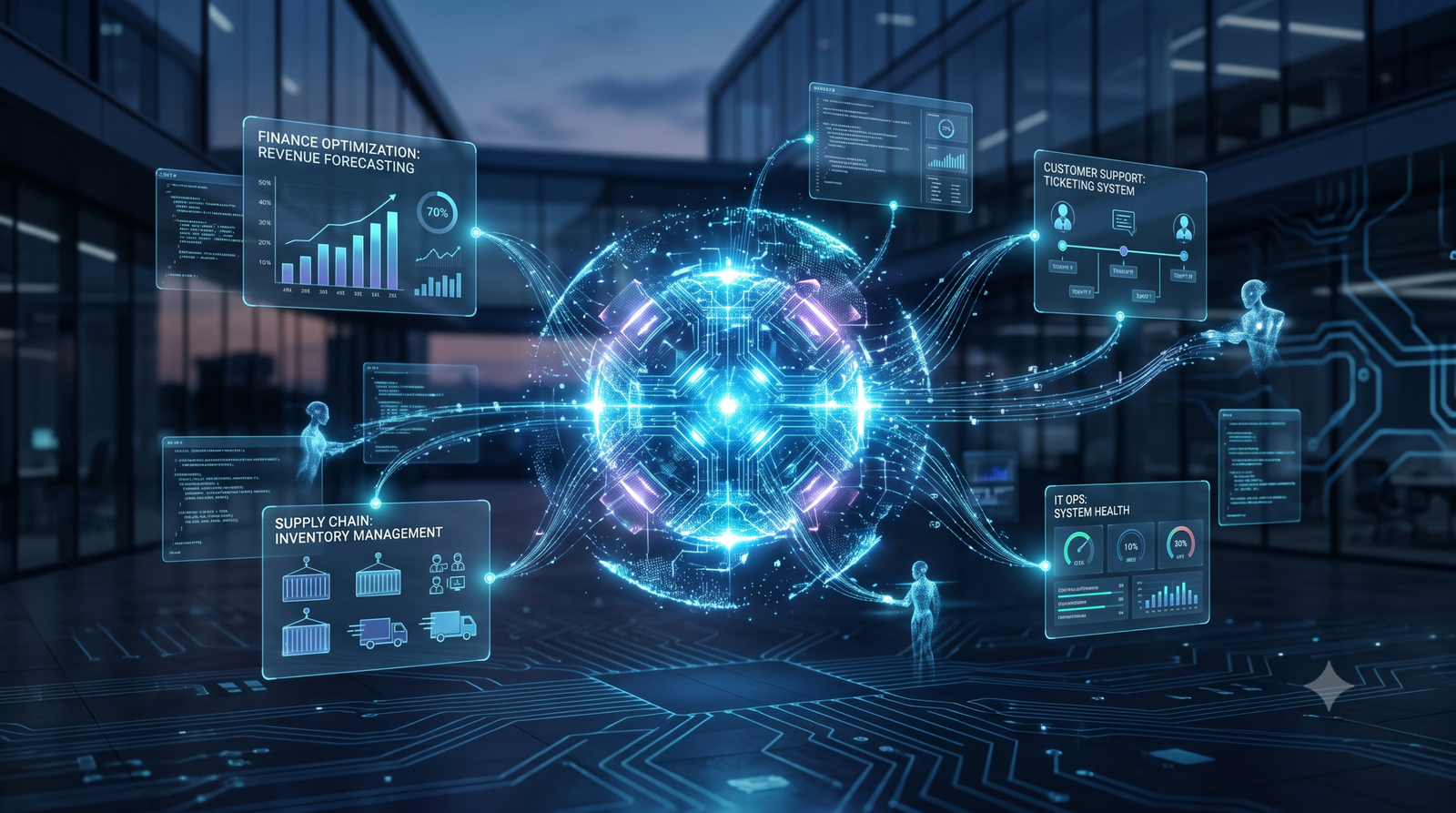
Artificial Intelligence has undergone a dramatic evolution over the past few years. While generative AI models and conversational chatbots captured global attention by summarizing text and generating creative content, a far more impactful shift is taking place in 2026: the rise of Autonomous AI Agents.
Unlike traditional Large Language Models (LLMs) that simply respond to static prompts, AI agents possess the ability to plan, reason, execute multi-step workflows, and interact with external tools and software environments independently. This transition from passive AI tools to active agentic architectures is redefining enterprise automation across industries.
What Are Autonomous AI Agents?
An autonomous AI agent is a software system powered by advanced AI models that can perceive its environment, formulate sub-goals, select appropriate tools, and execute sequential actions to accomplish complex objectives without continuous human intervention.
Key components of modern AI agents include:
- Perception and Context Understanding: Processing multimodal inputs, document structures, and live system state updates.
- Planning and Reasoning: Breaking down high-level instructions into structured, step-by-step execution plans.
- Tool Usage and Integration: Connecting natively via APIs to databases, CRMs, cloud infrastructure, and internal enterprise software.
- Memory Management: Maintaining short-term context during task execution and long-term memory for personalized and compliant decision-making.
Beyond Legacy Automation: AI Agents vs. Traditional RPA
For years, enterprises relied on Robotic Process Automation (RPA) to streamline repetitive administrative tasks. However, legacy RPA systems suffer from a critical limitation: fragility. If a UI element shifts or an unexpected exception occurs, hardcoded RPA scripts fail.
AI agents solve this fundamental flaw through adaptive problem-solving:
| Feature | Legacy RPA | Autonomous AI Agents |
| Execution Style | Rule-based, rigid scripts | Goal-oriented, adaptive reasoning |
| Data Handling | Structured data only | Unstructured & structured data |
| Exception Management | Fails on unexpected inputs | Dynamic error recovery & re-planning |
| Integration | Surface-level UI scraping | Native API orchestration & dynamic tool use |
High-Impact Enterprise Use Cases in 2026
1. IT Operations & DevOps Auto-Remediation
Modern cloud infrastructures generate thousands of alerts daily. Autonomous AI agents analyze system telemetry, diagnose root causes of server outages or performance bottlenecks, and execute remediation protocols automatically—significantly reducing Mean Time to Resolution (MTTR).
2. Intelligent CRM & Customer Operations
Rather than routing customers through frustrating decision-tree menus, AI agents interact naturally with users, retrieve order histories from back-end databases, issue refunds within authorized policy limits, and update CRM records seamlessly in real time.
3. Supply Chain & Procurement Orchestration
AI agents continuously monitor global supply chain feeds, weather forecasts, and inventory levels. When potential disruptions occur, agents can autonomously re-route shipments, evaluate supplier pricing alternatives, and draft purchase orders for manager approval.
Overcoming Key Challenges: Security and Governance
As organizations grant AI agents greater autonomy, establishing robust governance frameworks becomes mandatory. Leading enterprises are implementing:
- Human-in-the-Loop (HITL) Guardrails: Requiring explicit human confirmation for high-stakes actions, such as financial transactions above set thresholds.
- Granular Role-Based Access Control (RBAC): Ensuring agents operate strictly within permitted API parameters and data privacy boundaries.
- Comprehensive Audit Trails: Logging every reasoning step, API call, and system decision for compliance and security reviews.
Conclusion: Preparing for the Agentic Future
The transition toward autonomous AI agents marks a fundamental milestone in business technology. Organizations that successfully integrate agentic workflows into their operations will unlock unprecedented levels of efficiency, agility, and scalability.
For IT leaders, developers, and technology managers, the key to success in 2026 lies in building secure, modular, and well-governed environments where AI agents and human teams work side by side to drive innovation.