

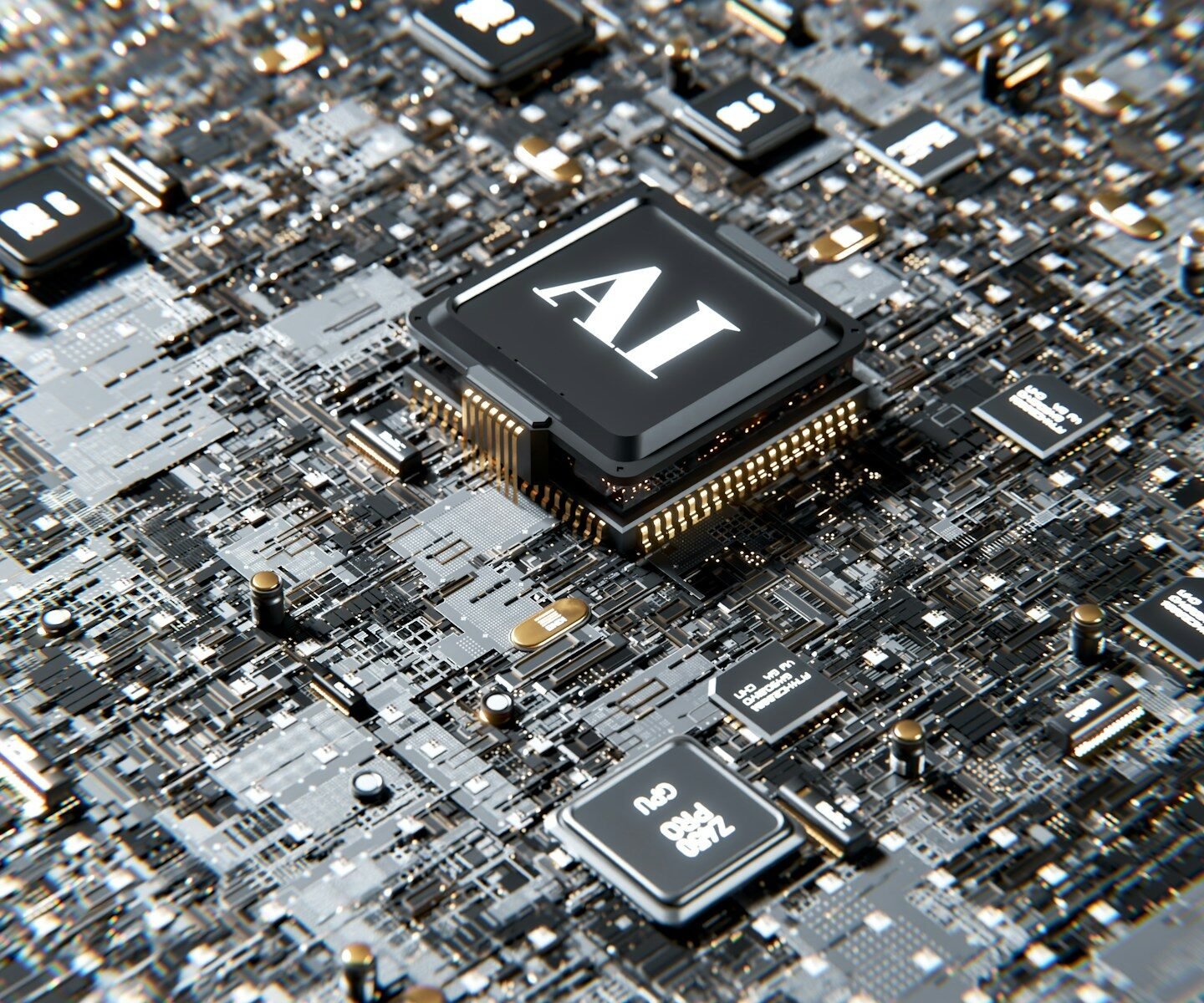
The year 2026 represents a structural inflection point in human history, marking the end of the era defined by centralized cloud-compute bottlenecks. We are entering a “Golden Age” where intelligence is no longer a distant service but a local utility. At Nabil IT, we view this shift as the convergence of three primary vectors: a $1 trillion silicon backbone, the resolution of decades-old mathematical conjectures, and the maturation of decentralized finance. The catalyst for this era was the May 2026 breakthrough in pure mathematics, which provided the algorithmic efficiencies required to optimize the massive semiconductor expansion now powering our world. This is no longer a pehttps://nabil-it.com/wp-content/uploads/2024/12/vintage-electrical-and-electronic-appliances-in-an-2023-11-27-05-10-10-utc-e1734923695564.jpgd of experimental tools, but a paradigm shift toward pervasive, high-throughput local intelligence.
2. THE SILICON BACKBONE: THE GLOBAL SEMICONDUCTOR MARKET’S $1 TRILLION SURGE
The WSTS Autumn 2025 forecast confirms that the semiconductor industry is on a relentless trajectory toward a trillion-dollar valuation. After a massive 22.5% surge in 2025 (reaching $772 billion), the market is forecast to expand by 26.3% in 2026, totaling approximately $975.5 billion.
This growth is bifurcated between the massive demand for AI training logic and the high-bandwidth memory (HBM) required for local inference.
| Product Category | 2025 YoY Growth (Actual/Projected) | 2026 YoY Growth (Forecast) |
|---|---|---|
| Logic | 37.1% | 32.1% |
| Memory | 27.8% | 39.4% |
| Integrated Circuits (Total) | 25.6% | 29.0% |
| Total World Market | 22.5% ($772B) | 26.3% ($975B) |
Regional Market Intelligence:
- The Americas Surge: Leading global expansion with a staggering 34.4% growth rate in 2026, driven by hyperscale data center construction.
- Asia Pacific Dominance: Sustaining a high-plateau growth of 24.9%, serving as the primary manufacturing hub for AI-specific logic.
- The Japan Rebound: After a concerning -4.1% contraction in 2025, Japan is forecast to rebound sharply with 11.9% growth in 2026 as automotive and consumer electronics realign with AI-integrated supply chains.
- Europe: A steady recovery continues, with low double-digit growth forecast at 11.6%.
3. MATHEMATICAL REVOLUTION: GENERATIVE AI AND THE DEATH OF CONJECTURES
In May 2026, the mathematical world faced a “Sputnik moment.” OpenAI’s generative models resolved the unit distance conjecture, a landmark problem in discrete geometry posed by Paul Erdős in 1946. This wasn’t merely a computational feat; it demonstrated AI’s ability to act as a reasoning partner.
The true breakthrough in human-AI convergence occurred just one week later. Human researchers, building on the central technique introduced by the AI’s proof, successfully solved the sum-product conjecture. This symbiotic relationship is the hallmark of the new “Golden Age of Mathematics.”
Erdős Problems & Graph Theory Named after Paul Erdős, these hundreds of unsolved problems are the ultimate stress tests for logical reasoning. Geometric graph theory and Ramsey theory are uniquely suited for AI intervention because they involve identifying elusive counterexamples within massive, multi-dimensional structures. AI-driven proofs allow us to navigate these “petabyte-scale” logical landscapes that are physically impossible for human experts to verify alone.
The Technological Triad The 2026 mathematical landscape is governed by three pillars:
- Computational Tools: Supercomputing clusters modeling complex phenomena like climate and Ramsey numbers.
- Proof Verification: Specialized computer languages that check AI-generated arguments against fundamental axioms to ensure 100% logical integrity.
- Artificial Intelligence: The creative “conjecture engine” that suggests non-obvious patterns for humans to refine.
4. GENERATIVE AI EVOLUTION: THE GPT-5.6 FAMILY & CYBERSECURITY STRATEGY
The July 2026 release of GPT-5.6 shifted the industry’s focus from “more parameters” to “operational efficiency.” For technical architects, the most impressive metric is that the flagship Sol model consumes 54% fewer tokens for programming tasks than its predecessors, drastically reducing OpEx for enterprise codebases.
The Model Tiering & Competitive Landscape OpenAI has positioned the 5.6 family to directly challenge Anthropic’s dominance in the institutional sector.
| Model | Professional Positioning | Competitor Benchmark | Price (In / Out per 1M) |
|---|---|---|---|
| Sol | High-performance / Logic-heavy | Beats Anthropic’s Latest | $5.00 / $30.00 |
| Terra | Mid-range / Throughput-focused | Beats Fable 5 | $2.50 / $15.00 |
| Luna | Economic / General Utility | Beats Opus 4.8 | $1.00 / $6.00 |
Cybersecurity and “ChatGPT Work” GPT-5.6 is now the gold standard for cybersecurity, capable of real-time threat analysis and automated “Red Team” simulations. The newly launched ChatGPT Work tool bridges the gap between raw LLM power and corporate productivity, providing a cross-platform (Web, PC, and Mobile) environment for secure document and presentation generation.
5. THE HARDWARE TRANSITION: AI PCS AND THE POWER OF THE NPU
In 2026, the “AI PC” is no longer a niche category—it is the baseline requirement. The architectural shift focuses on the NPU (Neural Processing Unit), which provides low-energy execution of neural networks, preserving battery life while running persistent local AI agents.
2026 Flagship Comparison (Minimum 40+ TOPS NPU):
- Apple MacBook Pro (M5):
- Features the M5 Pro/Max silicon with an enhanced Neural Engine.
- 16GB to 64GB unified memory; storage configurations up to 2TB SSD.
- Microsoft Surface Copilot+ (2026):
- Snapdragon X Elite or Intel Core Ultra AI options.
- Deep integration with Copilot for real-time meeting summarization.
- Lenovo ThinkPad X1 AI:
- Optimized for data analysis with up to 64GB of RAM and a 2TB NVMe SSD.
- Focused on enterprise-grade stability and hardware-level AI security.
- ASUS Zenbook Duo AI:
- Dual OLED high-resolution screens for creative multitasking.
- Utilizes LPDDR5X memory for maximum throughput in creative AI suites.
6. FINANCIAL MATURITY: CRYPTO TRENDS & ASSET TOKENIZATION
The digital asset market has moved from speculation to institutional infrastructure. Real World Asset (RWA) Tokenization—representing physical assets like real estate and commodities on the blockchain—is now a designated European banking phttps://nabil-it.com/wp-content/uploads/2024/12/vintage-electrical-and-electronic-appliances-in-an-2023-11-27-05-10-10-utc-e1734923695564.jpgrity.
Strategic Advantages of RWA:
- Fractionalization: Lowering the barrier to entry for high-value assets.
- Disintermediation: Direct settlement reduces middle-office costs.
- Settlement Velocity: Moving from T+2 days to near-instantaneous.
- Market Democratization: Universal access to previously gated asset classes.
Regulation & Stability The MiCA regulation in Europe has provided the legal certainty necessary for the Digital Euro to emerge as a strategic response to the digitalization of the economy. This, combined with Chainlink’s interoperability protocols, allows isolated institutional blockchains to communicate with the broader financial ecosystem securely.
7. CONNECTIVITY 2.0: 6G AND THE INTERNET OF SENSES
As we close 2026, 6G is transitioning from theory to early deployment. Defined as the “Internet of Senses,” 6G offers the sub-millisecond latency required for haptic feedback and immersive digital-physical environments. It is the final piece of the 2026 nexus, turning the internet into a pervasive sensory extension of the human experience.
8. CONCLUSION: SYNTHESIZING THE 2026 LANDSCAPE
The 2026 landscape is a unified ecosystem of Applied Technology. We see a virtuous cycle: AI-driven mathematics optimizes the next generation of silicon, which powers the local NPUs that secure our RWAs and facilitate our 6G-enabled sensory interactions. As an architect, the takeaway is clear: the future belongs to those who can manage intelligence at the edge.
Call to Action: With the Sol model offering 54% token efficiency, are you ready to migrate your enterprise logic to local NPUs, or does the raw scale of the cloud still dominate your TCO strategy? Share your architecture plans below.
- Market Cap: The semiconductor market is projected to reach $975.5 Billion by year-end, with the Americas leading at 34.4% growth.
- GPT-5.6 Sol TCO: Professional-grade tokens are priced at $5 (Input) / $30 (Output) per million, offering 54% higher efficiency in coding tasks.
- Local Intelligence: The 2026 hardware standard requires an NPU with 40+ TOPS for efficient, low-energy local inference.
- Math Breakthrough: AI solved the 80-year-old unit distance conjecture in May 2026, sparking a new era of AI-human collaborative proofs in Ramsey theory.
- Institutional Finance: RWA Tokenization is now a European banking phttps://nabil-it.com/wp-content/uploads/2024/12/vintage-electrical-and-electronic-appliances-in-an-2023-11-27-05-10-10-utc-e1734923695564.jpgrity, supported by MiCA and the strategic rollout of the Digital Euro.