

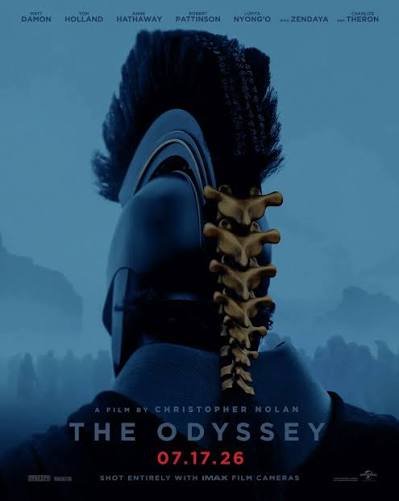
When director Christopher Nolan announced his adaptation of Homer’s ancient epic, “The Odyssey”, cinephiles and tech enthusiasts alike knew it would push the boundaries of modern filmmaking.Budgeted at over $\$250\text{ million}$ and featuring an all-star cast including Matt Damon, Tom Holland, Anne Hathaway, Robert Pattinson, Lupita Nyong’o, Zendaya, and Charlize Theron, the $172\text{-minute}$ epic is more than a storytelling triumph—it is a towering milestone in engineering and camera hardware.
Today at Nabil IT, we break down the incredible physical and optical technology that brought The Odyssey to life.
                    [ PRODUCTION TECH OF "THE ODYSSEY" ]
                                     │
     ┌───────────────────────────────┼───────────────────────────────┐
     ▼                               ▼                               ▼
[ 100% IMAX 70mm Cameras ]  [ Real-Time Firelight Rigging ]   [ Practical Mechanical Builds ]
Whisper-Quiet Custom Bodies  Portable Sync-LED Color Arrays   Life-Sized Ships & Trojan Horse
1. The World’s First Film Shot 100% on IMAX 70mm Cameras
While Nolan has famously utilized IMAX 70mm cameras for key action sequences in The Dark Knight, Dunkirk, Tenet, and Oppenheimer, The Odyssey is the first feature-length narrative movie in history shot entirely using IMAX film cameras.
The Technical Challenge:
Traditional $70\text{ mm}$ IMAX cameras are massive, extremely heavy, and notohttps://nabil-it.com/wp-content/uploads/2024/12/vintage-electrical-and-electronic-appliances-in-an-2023-11-27-05-10-10-utc-e1734923695564.jpgusly loud. The vacuum systems and high-speed film transportation motors create a deafening whirring sound that makes recording live on-set dialogue virtually impossible without heavy post-production dubbing (ADR).
The Breakthrough:
To overcome this, IMAX engineers collaborated directly with Nolan and cinematographer Hoyte van Hoytema to develop a newly redesigned, lighter, and whisper-quiet generation of $70\text{ mm}$ IMAX film camera bodies.
- Over $600\text{ kilometers}$ of physical film stock were run through these custom camera bodies across 91 days of principal photography.
- The expanded $1.43:1$ native aspect ratio captures unprecedented vertical detail, filling full-scale IMAX screens from floor to ceiling.
2. Revolutionary Lighting: Real-Time LED Firelight Arrays
Capturing night raids, ancient sea battles, and candlelit palaces across outdoor locations in Greece, Malta, Morocco, Iceland, and Scotland presented a massive exposure challenge for analog film.
To maintain naturalistic illumination without relying on artificial studio lighting or CGI post-processing, Hoyte van Hoytema engineered a custom lighting system:
- Synchronized Portable LED Arrays: Hundreds of micro-LED panels were rigged onto portable frames and programmed with algorithmically randomized flicker patterns.
- Exact Color Temperature Matching: The rigs replicated the precise Kelvin color spectrum of open wood flames, allowing camera operators to move $360\text{ degrees}$ around actors during night shoots while maintaining exposure on $70\text{ mm}$ film stock.
3. Practical Engineering Over Green Screens
In an era dominated by digital volume stages and green screens, Nolan doubled down on tactile, physical engineering:
- The Sea-Borne Trojan Horse: Rather than generating a digital creature, production teams constructed a fully articulated, life-sized physical Trojan Horse designed to float across open seawater and be hauled ashore by real extras.
- Seafaring Triremes: Ancient Greek ships were physically built and fitted with hidden hydraulic stabilizing gimbals, allowing crew members to shoot in turbulent open waters with real physical spray and momentum.
4. The 70mm Projection Phenomenon: Analog Mechanics in a Digital World
Exhibiting The Odyssey in its intended $70\text{ mm}$ IMAX film format requires projection technology that borders on industrial engineering:
| Feature | Digital Projection | True $70\text{ mm}$ IMAX Film |
|---|---|---|
| Aspect Ratio | $1.90:1$ (Standard Digital) | Full $1.43:1$ (Expanded Vertical View) |
| Projector Weight | Standard Server Rack | $>2\text{ Tons}$ ($5.5\text{ ft}$ tall, $6.5\text{ ft}$ long) |
| Illumination System | Standard Laser Engine | $15,000\text{ W}$ Xenon Lamp with Water-Cooling Pump |
| Film Reel Size | Digital Hard Drive / Cloud Stream | Almost $600\text{ lbs}$ of Physical Cellulose Roll |
Because physical film projection has largely been phased out worldwide, operating these massive $70\text{ mm}$ projectors requires specialized projectionists who monitor xenon water pumps and heavy platter transport systems in real time.
Final Verdict
“The Odyssey” proves that the pinnacle of cinema technology isn’t always found inside a computer processor or AI render farm. By pairing century-old analog chemistry with cutting-edge optical and mechanical engineering, Christopher Nolan has delivered a visual experience that redefines what physical film can achieve.
Have you experienced “The Odyssey” in 70mm IMAX yet, or are you watching it in digital theaters? Share your review in the comments below, and subscribe to Nabil IT for more deep-dives into hardware, cinema tech, and digital innovation!