

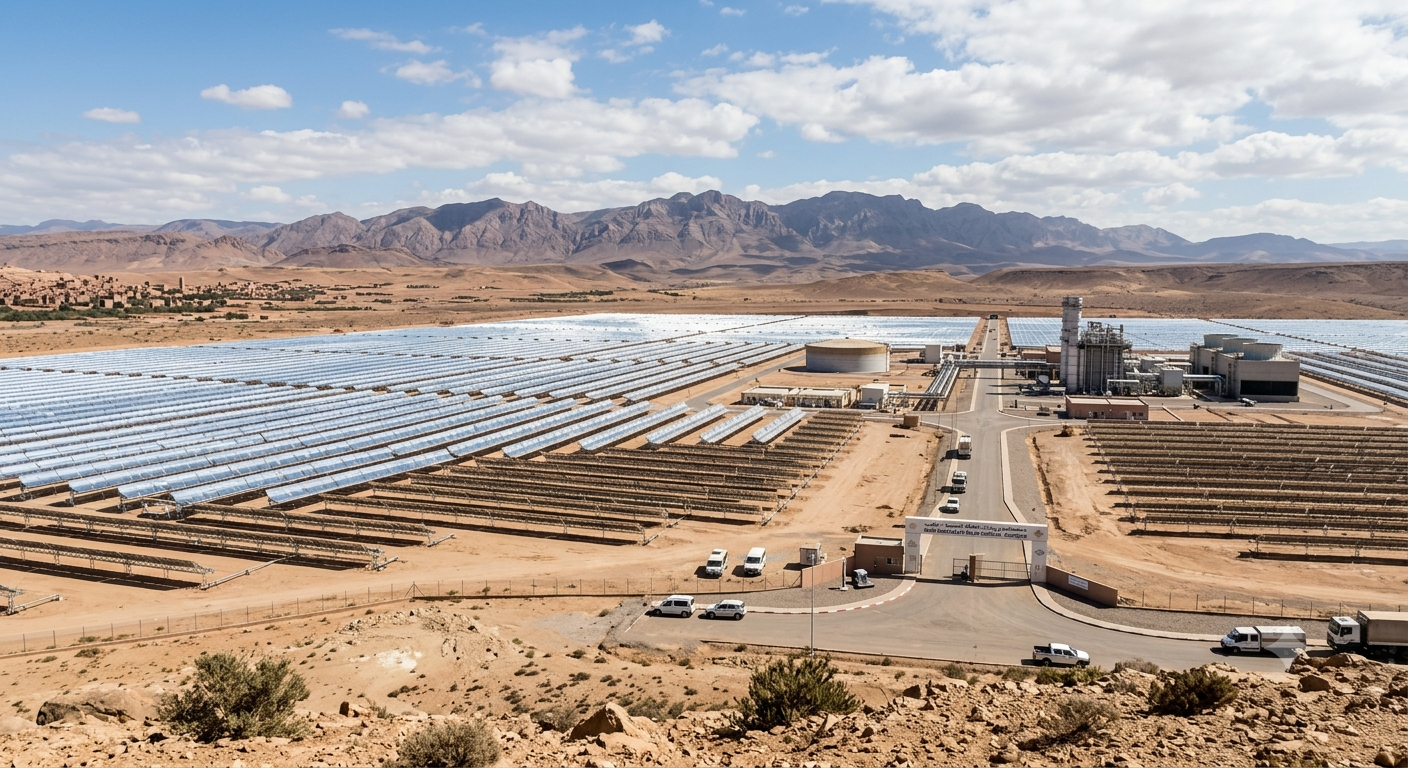
Rising dramatically out of the sun-baked, rocky deserts at the gateway to the Sahara, the Noor Ouarzazate Solar Power Station in Morocco is nothing short of an engineering marvel. Covering over $3,000 \text{ hectares}$ (equivalent to roughly $3,400$ soccer fields), this sprawling industrial oasis is visible from space.
For years, it has stood as the poster child of Africa’s green energy transition. Orchestrated by the Moroccan Agency for Sustainable Energy (MASEN), the complex has a combined generation capacity of approximately $582 \text{ MW}$, supplying clean, reliable energy to over a million Moroccans.
However, behind the glittering mirrors lies a complex matrix of technological breakthroughs, extreme environmental challenges, and high-stakes financial calculations.
Today at Nabil IT, we present an exhaustive, multi-dimensional critique of Noor Ouarzazate: exploring its technological mechanics, its real-world effectiveness, and a balanced evaluation of its pros, cons, and future viability.
1. Technical Blueprint: How the Giant Works
Unlike typical solar farms that use flat, bluish Silicon Photovoltaic (PV) panels to turn sunlight directly into electricity, Noor Ouarzazate relies primarily on Concentrated Solar Power (CSP).
CSP uses giant mirrors to focus sunlight onto a specific receiver, heating up a fluid to extreme temperatures. This heat is then used to boil water, create high-pressure steam, and spin a traditional turbine to generate electricity.
The complex is divided into four distinct phases, each utilizing unique solar technologies:
                  [ NOOR OUARZAZATE SOLAR COMPLEX ]
                                 │
     ┌───────────────────────────┼───────────────────────────┐
     ▼                           ▼                           ▼
[ Noor I & II ]              [ Noor III ]                [ Noor IV ]
Parabolic Troughs           Central Solar Tower         Standard Photovoltaic (PV)
(Wet & Dry Cooling)         (Helio-tracking Tower)      (Direct Generation)
Phase I: Noor I (160 MW – Parabolic Troughs)
Inaugurated in 2016, Noor I utilizes Parabolic Trough technology. Over half a million curved mirrors track the sun throughout the day, focusing solar radiation onto steel tubes filled with a synthetic heat transfer oil (Thermal Oil). This oil is heated to roughly $393^\circ\text{C}$ before transferring its heat to a steam generator. It features a Molten Salt Thermal Storage capacity of $3 \text{ hours}$.
Phase II: Noor II (200 MW – Parabolic Troughs)
Completed in 2018, Noor II improves on its predecessor’s design. While it still uses parabolic troughs, it upgrades the thermal storage capacity to a massive $7 \text{ hours}$ and shifts from wet-cooling to dry-cooling systems to conserve water.
Phase III: Noor III (150 MW – Central Solar Tower)
Noor III is the most visually striking phase of the complex. Abandoning troughs, it features a massive $243\text{-meter-tall}$ central solar tower surrounded by thousands of giant flat mirrors (heliostats) that track the sun on two axes.
These mirrors focus sunlight directly onto a receiver at the top of the tower, heating molten salt directly to over $560^\circ\text{C}$. This phase boasts $7.5 \text{ hours}$ of energy storage and represents a major leap in thermal efficiency.
Phase IV: Noor IV (72 MW – Photovoltaic)
To diversify the complex and bring down average production costs, Noor IV was built using standard Photovoltaic (PV) technology. It has no storage capacity but provides highly cost-effective electricity during peak daylight hours.
2. The Storage Miracle: Defeating the “Intermittency” Problem
The primary argument against renewable energy is intermittency—the sun does not always shine, and the wind does not always blow. Grid operators struggle to balance supply and demand when solar power suddenly drops off at sunset.
Noor Ouarzazate’s CSP technology solves this fundamental problem through its Molten Salt Thermal Energy Storage (TES).
During the day, excess thermal energy from the receivers is transferred to massive insulated tanks filled with a mixture of sodium nitrate and potassium nitrate. This salt liquefies and acts as a massive thermal battery, storing heat at temperatures exceeding $500^\circ\text{C}$.
When the sun sets, or when clouds roll in, the system pumps the hot liquid salt through heat exchangers to generate steam, keeping the turbines spinning. This allows Noor Ouarzazate to generate baseload-style power well into the night, perfectly matching Morocco’s evening energy peak.
3. The Positives (The Success Pillars)
Noor Ouarzazate has yielded immense benefits for Morocco’s geopolitical, environmental, and socio-economic posture.
A. Geopolitical Sovereignty & Energy Security
Historically, Morocco imported over $95\%$ of its energy needs, relying heavily on foreign coal, oil, and gas. This made the nation highly vulnerable to volatile global energy market fluctuations. Noor Ouarzazate has acted as a catalyst for energy independence, proving that local natural resources (abundant Saharan sunshine) can sustain heavy national grid demands.
B. Massive Carbon Offsetting
The environmental metrics of the plant are staggering. By substituting fossil fuels with clean solar power, the complex prevents the emission of:
- Over $760,000 \text{ tonnes}$ of $CO_2$ annually.
- Accumulated reduction projection of more than $17.5 \text{ million tonnes}$ of greenhouse gases over a standard $25\text{-year}$ operational cycle.
This aligns seamlessly with Morocco’s ambitious goal of generating over $52\%$ of its electricity from renewable sources by 2030.
C. Global CSP Blueprint and Knowledge Sharing
Noor Ouarzazate has served as a real-world testing ground for international solar research. Organizations like the World Bank, the African Development Bank (AfDB), and European development banks (such as KfW) have studied the project to optimize solar field integration, heliostat control algorithms, and turbine start-up behaviors globally.
B. Local Socio-Economic Integration
Rather than acting as an isolated industrial enclave, MASEN implemented a comprehensive Social Development Plan (SDP). Millions of dollars derived from land transactions and operations have been reinvested back into the surrounding Drâa-Tafilalet communities:
- Infrastructure Upgrades: Paved roads, medical centers, and fresh drinking water networks have been extended to previously isolated rural villages.
- Local Specialized Education: MASEN helped fund the establishment of IFMEREE (a specialized vocational training institute in Ouarzazate) and new engineering courses at the local university, ensuring local youths are trained to maintain the green plants of the future.
4. The Criticisms and Key Challenges (The Cons)
Despite its massive achievements, the Noor Ouarzazate project is a subject of intense scrutiny from environmentalists, economists, and engineers. The project faces several critical challenges:
A. The Water Footprint Paradox
Perhaps the most glaring paradox of Noor Ouarzazate is its water consumption in an hyper-arid region.
Morocco is experiencing historic multi-year droughts driven by climate change. Yet, Noor Ouarzazate draws an estimated $2.5 \text{ to } 3 \text{ million } m^3$ of water annually from the nearby Mansour Ed-Dahbi Reservoir—the exact same reservoir that surrounding agricultural communities and citizens rely on for drinking water and crop irrigation.
- Wet Cooling (Noor I): The steam turbines in Noor I rely on “wet cooling” systems, which evaporate vast amounts of water to condense the steam back into liquid water.
- Mirror Cleaning: Thousands of mirrors must be kept pristine. In a dusty desert environment, fine sand constantly settles on the heliostats. Dust build-up blocks light absorption, causing immediate drops in generation efficiency. Cleaning these mirrors requires intensive, high-pressure washing with purified water.
While phases II and III transitioned to “dry cooling” to dramatically lower water consumption, the total usage remains a highly sensitive issue for local drought-stricken farming communities.
B. High Financial Capital (CAPEX) & Subsidization Debt
Constructing CSP facilities is extraordinarily expensive. Noor I alone cost over $\$840 \text{ million}$, and the total cost of the complex exceeds several billion dollars, heavily funded by international development loans.
Furthermore, the price of standard Photovoltaic (PV) solar panels collapsed during the 2010s and 2020s, making PV power vastly cheaper to generate than CSP power. While CSP offers night-time storage, its generation costs are significantly higher per megawatt-hour.
This created a financial gap: MASEN purchased the power from the plant’s operating consortium (led by Saudi developer ACWA Power) at higher rates but had to resell it to the national utility (ONEE) at lower consumer rates. The government has had to subsidize this margin, placing a continuous financial strain on the national budget.
C. Technical Vulnerabilities and Operational Downtime
Noor III’s central receiver tower, though highly efficient, represents a technically complex setup with a higher risk of downtime. For instance, in early 2024, Noor III suffered a major technical failure in its molten salt storage system, resulting in a temporary shutdown and lost generation revenue estimated at several million dollars before being repaired and successfully restarted. Keeping such cutting-edge thermal infrastructure running seamlessly in extreme desert temperatures is a constant, highly costly battle.
Technical Summary of Noor Ouarzazate
| Metric | Noor I | Noor II | Noor III | Noor IV |
|---|---|---|---|---|
| Technology | Parabolic Trough | Parabolic Trough | Central Solar Tower | Photovoltaic (PV) |
| Capacity | $160 \text{ MW}$ | $200 \text{ MW}$ | $150 \text{ MW}$ | $72 \text{ MW}$ |
| Storage Time | $3 \text{ Hours}$ | $7 \text{ Hours}$ | $7.5 \text{ Hours}$ | None |
| Cooling Method | Wet Cooling | Dry Cooling | Dry Cooling | Passive |
5. The Verdict: Successful Milestone or Costly Experiment?
Is Noor Ouarzazate a success? The answer is not binary.
If the metric is technological courage, carbon displacement, and national prestige, Noor Ouarzazate is a spectacular triumph. It proved that a developing country can execute a mega-infrastructure project, and it validated the long-term potential of utility-scale thermal energy storage.
However, if evaluated strictly on economic efficiency and ecological sustainability, the project serves as a cautionary tale. The high water demands in a hyper-arid, drought-threatened valley highlight the friction between global climate goals (decarbonization) and local climate adaptations (water conservation).
For future projects, Morocco has learned these lessons well. The country’s subsequent mega-projects (such as Midelt) are shifting toward hybrid models—combining cheaper PV solar for daytime generation with smaller CSP units or advanced battery storage for nighttime, while shifting entirely to dry-cleaning and dry-cooling setups.
What are your thoughts on Morocco’s mega-solar strategy? Is the trade-off of precious water resources worth the clean energy security? Let us know your perspective in the comments below, and subscribe to Nabil IT for more in-depth analyses of global green tech!